Dental Biomechanics: Where Engineering and Medicine Combine Their Expertise
How can we better preserve teeth when they need to be restored? For Elsa Vennat, a faculty researcher at the Paris-Saclay Mechanics Laboratory (LMPS), the answer lies in part in a better understanding of their mechanical behavior. From her research on dental tissues to her collaborations with healthcare professionals, she demonstrates how the dialogue between engineering and medicine can help advance dental restoration techniques.
Le 28 October 2026#Recherche
Image
Partager
You are currently a faculty member and researcher at LMPS and a specialist in the biomechanics of biological tissues, particularly teeth. How did you discover this field of research, and what inspired you to pursue it?
Image
During my senior year at ENS Cachan in civil engineering, I chose to pursue the Master 2 in Soil and Rock Mechanics in Their Environment at CentraleSupélec (then known as École Centrale Paris). I was very interested in the courses on porous media and the impact of water in these media. One internship topic caught my attention: the idea was to apply soil mechanics techniques to a biological tissue—dentin—to better understand how adhesive resins penetrate it. So there was this aspect related to porous media and the discovery of a whole new world: that of mineralized biological tissues.
What are the main challenges in restorative dentistry today, and how can your research in biomechanics help address them?
Image
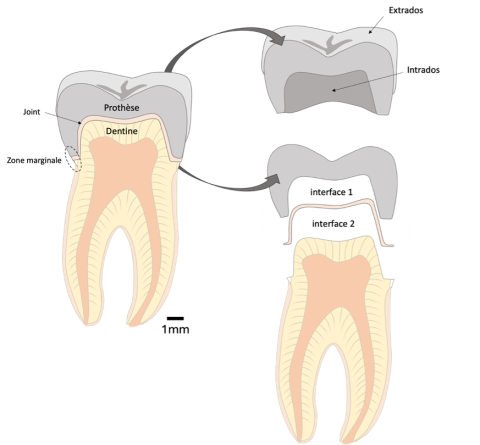
Schéma illustrant les interfaces entre dentine et prothèse, au cœur des recherches sur les restaurations dentaires.
I would say the challenge is to make a restoration last a lifetime: in fact, every time a restoration is replaced, it results in additional tissue loss and a more invasive restoration. One of the major advances in this regard has already been the promotion of minimally invasive dentistry—that is, removing as little tissue as possible to create a restoration—because there’s nothing better than natural tissue! To prevent failures, it is important to understand the biomechanics of the restored tooth. But the tooth is a complex organ composed of multiple materials and scales, and it is subjected to complex stresses. The role of researchers is to try to understand the most influential factors in order to model its behavior accurately and effectively once it has been restored. This will make it possible to offer restorations with superior mechanical performance. To achieve this, numerous challenges must be addressed: gaining a better understanding of the forces at work in the mouth, acquiring and processing “patient-specific” geometries to enable customized simulations, and gaining a deeper understanding of the behavior of the interfaces between prosthetics and dental tissues. Two avenues seem worth pursuing to improve dental care: • Developing solutions that incorporate mechanics early on (starting with the design of the prosthesis), since currently only geometric considerations are used to design prostheses. • or developing new biomimetic restorations
Your research, in particular, paves the way for restorations tailored to each tooth and each patient. How far can we go with this personalization, and what difference could it make for patients?
This is indeed a highly relevant and timely avenue of research with the advent of new additive manufacturing technologies, particularly in ceramics. We are developing this approach as part of the ANR Smarteeth project. How far should we go with biomimicry and customization? That is indeed the question we must answer to avoid going too far in these areas if there is no gain in performance. We must therefore be able to quantify this benefit. For example, we have shown through numerical simulations that restorations with property gradients can be beneficial in certain clinical cases. (Fouquet, V., Larsen, N., Stchepinsky, A.-C., Vennat, E., Benoit, A., Tapie, L., 2024. A parametric finite element analysis for functionally graded material overlay restoration. Journal of the Mechanical Behavior of Biomedical Materials 152, 106409.)
Your research lies at the intersection of engineering and dentistry. How do you actually work with professionals in the medical field, and what does this collaboration enable?
I believe that, as with any work at the intersection of disciplines, we must first establish a common vocabulary, and each expert must make an effort to acquire a basic understanding of the other disciplines. This is what I have been able to achieve with my colleagues—hospital practitioners and researchers. It takes time, but it’s truly rewarding when successful. Currently, I’m working with a multidisciplinary team of researchers on a rare disease that profoundly affects the structure of dentin, and our collaboration allows us to explore uncharted territory and make groundbreaking discoveries.
You also teach materials mechanics and biomechanics at CentraleSupélec. How do we prepare future engineers today to tackle challenges related to the medical field?
An engineer from CentraleSupélec is trained to solve complex problems and, thanks to interdisciplinary courses or projects in the “project” clusters, for example, he or she knows how to draw on knowledge from different disciplines to achieve this. The biomedical aspect is beginning to emerge in the curriculum. I try to offer introductory courses in biomechanics or more in-depth studies to students as early as their first year, and there is a specific track in the third year geared toward the biomedical field. The important thing is to be exposed to the challenges and issues in this field and, above all, to have the desire to pursue this exciting path.