Emobot: How Can AI Better Monitor Mental Health?
Founded by three CentraleSupélec graduates along with Professor Renaud Séguier, Emobot is developing an artificial intelligence-based app designed to continuously monitor changes in patients’ moods. Stemming from research in AI and signal processing, the solution was gradually developed in collaboration with healthcare professionals, driven by a practical need: to better monitor patients’ progress between appointments.


Starting with a Medical Need
In psychiatry, a consultation provides a snapshot of the patient’s condition at a given moment. But between appointments, a patient’s emotional state can change—sometimes gradually and without the patient immediately realizing it. It is precisely during this interval that Emobot seeks to step in.
“Doctors today spend very little time with their patients. We want to be the doctor’s eyes outside of appointments.” Tanel Petelot, CEO and co-founder of Emobot
The startup was founded in 2022 when three engineers from CentraleSupélec—Tanel Petelot, Antony Perzo, and Samuel Lerman—met with their professor, Renaud Séguier, a specialist in signal processing and head of the AIMAC (Artificial Intelligence for Multimodal Affective Computing). From the very beginning of the project, the challenge was to apply the capabilities of artificial intelligence to a concrete medical need: how can we better objectively track changes in a patient’s condition between appointments?
Transforming everyday signals into information useful to doctors
The technology developed is based on a multimodal approach: it analyzes various signals derived from everyday phone use, including facial expressions, voice, physical activity, and certain digital behaviors. The selection of these signals and the methods for analyzing them were developed at the intersection of medical knowledge and engineering expertise.
The goal is not to replace medical diagnosis, but to provide supplementary information that allows for better tracking of the patient’s progress over time. This approach addresses a particular challenge associated with mood disorders: symptoms can develop or reappear gradually, whereas clinical evaluations are necessarily one-time events. Emobot thus seeks to transform a series of “snapshots” taken during consultations into a more continuous timeline of the patient’s condition.
AI Designed to Integrate into the Care Pathway
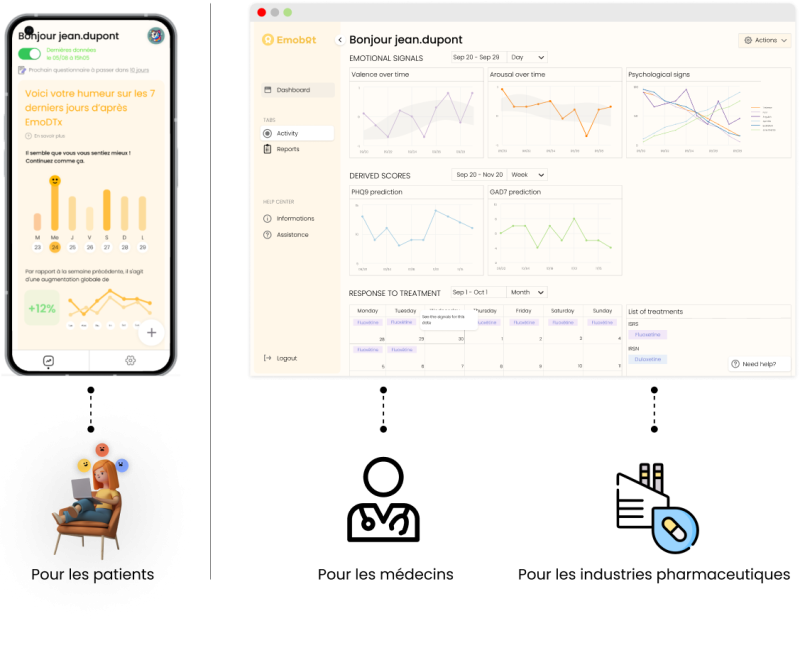
The dialogue between medical and technological expertise is not limited to the data to be analyzed. It also concerns how the results should be used in practice.
From a medical perspective, healthcare professionals do not access a stream of images, recordings, or raw data, but rather indicators that allow them to visualize changes in the patient’s condition. The app can also alert the patient when certain indicators deteriorate and encourage them to contact their doctor again. The goal is thus to create a monitoring system that integrates into the care pathway without adding unnecessary burdens for the patient.
One of the major challenges of such technology is, of course, the issue of personal data. Emobot has therefore designed its system around the principle of minimal data collection. Facial expression analysis is performed directly on the phone, and raw data—including images—is not stored. For voice data, the processing is also designed to retain only the scores derived from the analysis. The patient retains ownership of their data and chooses whether to share their progress with their doctor.
“Patients can relapse silently: their condition gradually deteriorates, and they may not necessarily realize it. The benefit of continuous monitoring is the ability to objectively track this progression and share it with the doctor.” Tanel Petelot, CEO and co-founder of Emobot
From AI Research to Medical Applications
Emobot’s story illustrates how research conducted at CentraleSupélec can gradually find application in the medical field. In its early days, Emobot was primarily developing a robot designed to detect early warning signs of depression in elderly residents of care facilities. The technology has gradually shifted its focus to monitoring mood disorders and supporting the care pathway.
Throughout this evolution, discussions with healthcare professionals also helped clarify what information to collect and how to present it so that it could be effectively integrated into medical practice.
The 11 clinical studies conducted with hospital and academic partners—particularly at the international level—then made it possible to test the technological developments against the realities of medical practice. After its launch in France, the medtech company is now focusing its commercial development on interventional psychiatry in the United States, where ongoing dialogue with practitioners will also be crucial for adapting the technology to patients’ needs and the realities of care pathways.
By bringing together artificial intelligence, signal processing, and medical practices, Emobot concretely illustrates why dialogue between engineers and physicians is essential for designing health technologies tailored to the needs of patients and healthcare professionals.
Learn more: Emobot