Polaris: Beyond Knowledge—Learning to Become an Engineer
The changes in the professional world require more than just new technical knowledge: they also demand the ability to adapt, collaborate, and make decisions when faced with unprecedented situations. Projects provide an ideal setting for developing these skills by exposing students to uncertainty, constraints, collective decision-making, and unforeseen circumstances. Through Polaris, a project led by CentraleSupélec’s Aerospace Club, some thirty first-year students faced this reality throughout the project, culminating in the launch of their experimental rocket at C’Space 2026. This experience changed project manager Neil Sherman’s perspective on the engineering profession.


Putting Knowledge to the Test in the Real World
Within the CentraleSupélec Aerospace Club (CACS), a student association dedicated to aerospace projects, the Polaris project brought together about thirty first-year students for a year to design an experimental rocket. Beyond building the rocket, the goal was to implement several experiments, including a roll control system, an altitude control system using air brakes, and the deployment of a satellite at apogee. After several months of design, fabrication, and testing, the rocket was launched in July 2026 during C’Space, the annual experimental rocket launch campaign organized by CNES and Planète Sciences.
A project of this scale exposes students to a reality different from that of academic instruction: for several months, they must transform theoretical knowledge into concrete solutions, while dealing with constraints related to time, manufacturing, and operation. For Neil Sherman, Polaris project manager, it is precisely this transition from theory to action that gives the project its full educational value:
Image
“The big difference from classroom instruction is the practical aspect—actually building something. With Polaris, we can put the knowledge we’ve acquired at the School into practice and link it to concrete skills. It’s also a way to realize what we’re capable of achieving and what we can contribute to a project,” explains Neil Sherman.
Test, Adjust, Decide
On a project of this scale, initial choices don’t always hold up when put to the test in the real world. As testing progresses, certain solutions must be modified or even abandoned. In particular, the roll control system had to be redesigned after tests showed that the available pressure was insufficient. The electronic circuit boards also encountered difficulties and had to be redone.
These unforeseen challenges force the students to make trade-offs. As the project progresses, they sometimes have to accept that they’ll need to scale back their initial ambitions, abandon certain avenues, or choose between several imperfect solutions. This has been a particularly formative experience for Neil Sherman:
“You also learn to accept that you won’t be able to do everything as planned. You have to know how to question your choices, make compromises, and sometimes give up certain things in order to see the project through to the end.”
This ability to make decisions in the face of the unexpected is one of the project’s key lessons. During the launch campaign, the students had to determine—under tight time constraints—which experiments could still be conducted and which ambitions had to be abandoned to enable the rocket’s launch.
A Rocket, but Above All, a Team
Polaris is built around three technical divisions (mechanical, electronics, and software), whose work is closely intertwined. A challenge in one area can quickly affect the others. For Neil Sherman, this interdependence makes communication essential to the project’s success:
“A rocket missing any one of these areas isn’t a rocket. All three areas must work together, communicate, and understand what the others are doing for the project to move forward,” he emphasizes.
Being a project manager, therefore, is not just about monitoring technical progress. It involves setting a course, coordinating the different teams, organizing deadlines, and ensuring that everyone remains engaged in the project. This responsibility is all the more unique because the team members are students—peers—who have voluntarily committed to the project.
This means learning how to rally the team, understand the challenges each person faces, reignite motivation when it wanes, and manage disagreements. Over the course of several months, the project thus becomes a very practical lesson in the human side of engineering: learning to communicate, to take everyone’s challenges into account, and to keep the team united around a common goal.
For Neil Sherman, this aspect is inseparable from the project’s technical success:
“You can have all the necessary technical skills, but if you don’t know how to communicate, you can’t make a team work.”
Engaging with the Professional World
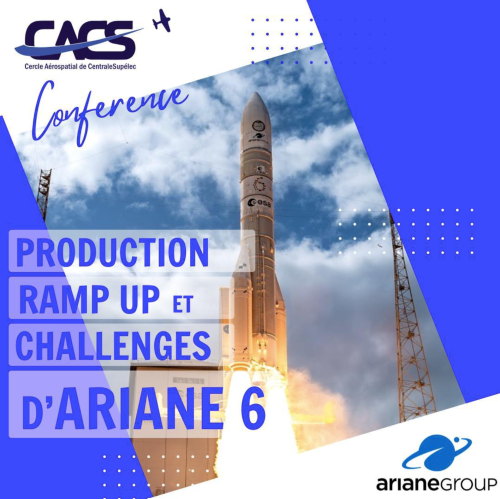
This experience is also enriched by interactions with industry professionals. Polaris benefits from the support of ArianeGroup and Archery Strategy Consulting. These partnerships give students the opportunity to gain a more direct understanding of the realities of the industry: discussions with engineers, technical advice, meetings with professionals, and company visits complement the experience gained through the project.
In particular, students were able to visit the ArianeGroup site in Les Mureaux and explore the Ariane 6 assembly floor. This provided a way to bridge the gap between the project developed at the School and the reality of the industry and its professions.
“These interactions help put the work done as part of Polaris into perspective and provide a better understanding of the realities of the sector and how projects are actually carried out,” emphasizes Neil Sherman.
Adaptability as a Key Skill
This hands-on experience with the project—including its constraints and unforeseen challenges—ultimately changed Neil Sherman’s perception of the engineering profession. Before Polaris, he primarily associated the profession with theory, calculations, or technical tools. His experience led him to a different conclusion:
“For me, the most important skills for an engineer are adaptability and the willingness to go beyond simply solving the problem.”
But this adaptability isn’t just about knowing how to react when a problem arises. It also involves staying curious, seeking to understand what’s happening beyond one’s own scope, and exploring new avenues. Throughout the project, Neil Sherman learned not to stop at solving a problem, but to look for what could still be improved, taking into account the project’s overall functioning.
This experience illustrates a conception of the engineering profession based as much on knowledge as on the ability to apply that knowledge, to collaborate, and to evolve. After all, adapting to changes in the professional world doesn’t just mean enduring them or reacting to them—it also means understanding the changes taking place, exploring new avenues, and helping to drive the evolution of projects, practices, and companies.
Learn more: