MSc in Artificial Intelligence
The Master of Science in Artificial Intelligence Applied to Society delivers academic excellence combined with operational, science-based knowledge directly aligned with major societal challenges.
This is a five-year higher education program (bac+5) that confers a Master’s degree, awarded internationally by CentraleSupélec.
APPLICATIONS FOR THE 2027 INTAKE ARE OPEN.

The program emphasizes practical application, preparing graduates to implement AI solutions within companies and organizations where artificial intelligence has become a strategic asset while maintaining high academic standards.
The MSc AI program is offered in one year after a 4-year Bachelor Degree or a Master Degree. Candidates who have not obtained 240 ECTS credits or who do not possess a sufficient scientific background to successfully complete the MSc in AI may enroll in a first-year level (M1) proposed by CentraleSupélec.
About
Artificial intelligence is now deeply embedded in everyday life and represents a transformative force for society. This program equips students with both foundational principles and advanced methodologies in AI, enabling them to become technical leaders in this rapidly evolving field.
The curriculum offers a distinctive approach by integrating model- and symbolic-driven methods with data-driven artificial intelligence techniques. Students explore how these approaches apply to critical societal domains, including sustainable development, new mobility systems, network infrastructures, Industry 4.0, finance, and health and well-being.
Delivered entirely in English by leading academics and industry professionals, the program provides a comprehensive end-to-end learning experience—from theory to real-world implementation. It is designed for students aiming to become AI architects and innovators, offering outstanding career prospects in one of the most dynamic and impactful disciplines of the 21st century.
The MSc in AI Applied to Society is officially certified and registered in the Répertoire National des Certifications Professionnelles (RNCP) by CentraleSupélec and the French Ministry of Higher Education and Research (Level 7 qualification).
Program
Artificial Intelligence is a dynamic field at the intersection of science and technology, developed to solve complex problems that require intelligent, adaptive solutions. Since its formal emergence in 1956, AI has advanced at an extraordinary pace, transforming industries and reshaping societies worldwide. By joining the MSc in Artificial Intelligence at CentraleSupélec, you will acquire the expertise needed to contribute to the responsible development of this transformative technology and help shape the future.
In a world increasingly shaped by AI, the program provides rigorous scientific training focused on innovation and societal impact. It addresses major economic, environmental, medical, industrial, and financial challenges, equipping students with both advanced technical competencies and a strong understanding of real-world applications.
M1 Program
T1 (september-december): core courses
- Mathematic
- Computer science
- Probability & statistics
- Machine Learning (foundations and applications)
- Model representation and analysis
T2 (january-april): hands-on learning
- Capstone projet: AI for real world physical systems
- Cross-lab and industrial innovation project
T3 (may-july): internship
Throughout the year : Profesionnalization and International Development
- Industrial conferences: context and issues
- Student pass
- Professionalization workshops
- AI cognition and ethics
- FLE and English
- Internship (3 months)
M2 Program
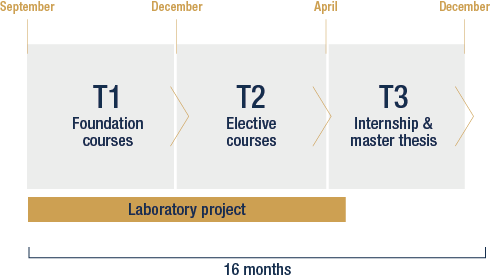
The M2 program is structured into three phases:
- Core courses provide fundamental and advanced knowledge of AI.
- Elective courses that allow specialization, conducted in parallel with a laboratory research project.
- A professional internship culminating in a Master’s thesis.
This structure ensures a comprehensive learning journey from theoretical foundations to applied research and professional practice.
Artificial Intelligence now impacts every sector of society. At CentraleSupélec, five specialized tracks allow you to explore how AI drives innovation in sustainable energy, healthcare/biomedical, transportation/mobility, industry of the future, and AI for finance—preparing you to design high-impact solutions for tomorrow’s challenges.
-
Renewable energy plays a huge part in the building of a better future, and Artificial Intelligence is a fundamental building block of the clean energy transition: contributing to the improvement and acceleration of the energy industry; improving our ability to understand and forecast energy demand; managing network infrastructures; and sustainably managing natural resources in a balanced way.
We face a further challenge as we strive to make Artificial intelligence energy efficient by optimizing AI architectures to balance efficiency and energy consumption.
-
Transportation accounts for a large part of energy consumption. Private cars are a major source of pollution. Transitioning to new forms of shared / sustainable mobility poses a considerable challenge. Artificial intelligence has a major contribution to make to the mobility revolution, particularly in the future of multimodal urban mobility.
Crucial areas include designing resilient public transport networks, addressing road safety for autonomous vehicles, predicting traffic flows to minimize congestion, and using AI for transport operations planning/regulation and asset management.
-
Artificial intelligence is a powerful lever for improving medicine and healthcare. The benefits of Artificial Intelligence in medicine and health are everywhere to be seen: improved pathology detection and diagnosis; personalized medicine; informed patient care; and better organized healthcare systems.
AI technologies and methods have already proven successful across a variety of health applications, and the potential for further progress is enormous.
In this sector, more than in others, Artificial intelligence designers face ethical questions about the respect for private data.
-
Digital, physical and virtual worlds generate massive shifts across industries. Artificial intelligence is central to this revolution. Typical examples of how Artificial intelligence contributes to industry transformation include predictive maintenance, digital twins and robotics.
The industrial systems of the future will involve collaboration between human operators and software agents, with the two working together (man-machine teaming). The challenges of this field of application require trustworthy, safe, robust, and explainable AI to design industrial systems of the future that are driven by humans.
-
Finance is one of the most data-intensive sectors in the modern world and is constantly evolving. Artificial intelligence is transforming financial services, enabling reassuring governance, relevant and intelligent decision-making, and real-time risk management, thereby refining the customer experience. It also supports the design of sustainable financial models grounded in fundamentals and helps assess the environmental impact of investments, contributing to the development of responsible financial strategies. At the same time, artificial intelligence raises crucial questions of transparency, explicability and fairness, particularly when algorithms can influence credit assessment or investment decisions. AI for Finance: to be at the forefront of tomorrow’s responsible and innovative financial systems.
Admission
Everything you need to know to apply.
Find deadlines, requirements, and guidance to join the MSc in AI program at CentraleSupélec.
-
M1
- L3 in science or Bachelor of Science (3 or 4 years), or Business Schools or University Diploma of Technology (BUT) or Health Studies (LAS)
- Minimum B2 level in English. Non-English-speaking native applicants must provide recent proof of proficiency (candidates who have completed a program entirely in English within the last three years are exempt from this requirement).
Accepted English proofs of proficiency for M1
English test
Minimum Score
TOEFL iBT 95
TOEFL iBT (new scale, since January 2026) 5/6
IELTS Academic 6.5
IELTS Online 6.5
Cambridge B2 First 175
TOEIC 4 Skills Listening ≥ 400 Reading ≥ 385 Speaking ≥ 160 Writing ≥ 150 M2
- Recent graduates or soon-to-be graduates who have validated at least 4 years of higher education - 240 ECTS (4-year bachelor's/Master 1...) - in Engineering, Mathematics, Statistics, Informatics, Physics… With little to no work experience.
- Minimum C1 level in English, and looking to study entirely in English. Non-English-speaking native applicants must provide recent proof of proficiency (candidates who have completed a program entirely in English within the last three years are exempt from this requirement).
Accepted English proofs of proficiency for M2
English test
Minimum Score
TOEFL iBT 95
TOEFL iBT (new scale, since January 2026) 5/6
IELTS Academic 7/9
IELTS Online 7/9
Cambridge B2 First 180/210
TOEIC 4 Skills Listening ≥ 490/495 Reading ≥ 455/495 Speaking ≥ 180/200 Writing ≥ 180/200 -
M1
For 2027 Intake
Online application deadline
Submit by 12 noon, Paris timeAdmission results
No later thanRound 1 Wednesday, November 25, 2026
Wednesday, January 20, 2027
Round 2 Wednesday, January 13, 2027
Wednesday, March 3, 2027
Round 3 Wednesday, February 17, 2027
Wednesday, March 31, 2027
Round 4 Wednesday, March 17, 2027
Wednesday, May 12, 2027
Round 5 Wednesday, May 19, 2027
Wednesday, July 7, 2027
M2
For 2027 Intake
Online application deadline
Submit by 12 noon, Paris timeAdmission results
No later thanRound 1 Wednesday, November 18, 2026
Wednesday, January 13, 2027
Round 2 Wednesday, January 6, 2027
Wednesday, February 24, 2027
Round 3 Wednesday, February 10, 2027
Wednesday, March 24, 2027
Round 4 Wednesday, March 10, 2027
Wednesday, May 5, 2027
Round 5 Wednesday, May 12, 2027
Wednesday, June 30, 2027
Faculty

Céline Hudelot
Explainability of Artificial Intelligence
Céline Hudelot is the co-academic director of the MSc in Artificial Intelligence and a Full Professor at CentraleSupélec, where she directs the MICS laboratory. Her research work is at the frontier of knowledge engineering, image processing, and representation learning.
Her current work focuses on the interpretability and explainability of artificial intelligence algorithms and associated learning paradigms such as domain adaptation, few-shot, active and incremental learning.
Publications: Google Scholar

Vincent Mousseau
Decision Modelling
Vincent Mousseau is a Full Professor at CentraleSupélec and a Researcher at the Mathematics and IT Laboratory for Complex Systems (MICS). He studies preference modelling and decision systems.
A former co-director of the MSc AI, he also heads the Complex Systems Engineering cluster at the Paris-Saclay University INTERFACES doctoral school.
Publications: Profile
Céline Hudelot
Academic Director of the M2 Program

Jean-Philippe Poli
Executive Director of the M2 Program

Maya Hage Hassan
Academic Director of the M1 Program

Laurence Carassus
Artificial Intelligence for Finance
Graduated from Paris-Dauphine University with a Master’s degree in Applied Mathematics and a Master’s Degree in Audit. She also holds a PhD and an HDR in Applied Mathematics.
Her work focuses on probability applied to finance and mathematical economics, particularly incomplete markets, with publications in leading journals.
Publications: Profile
Damien Challet
Artificial Intelligence for Finance
Damien Challet obtained his PhD in Theoretical Physics from Université de Fribourg in 2000. He joined the MICS lab at CentraleSupélec in 2011 where he is now full professor.
His research interests include agent-based modelling, statistical learning, cognitive biases, market microstructure, and large-scale human-made systems.
Publications: Google Scholar

Stergios Christodoulidis
Deep Learning
Stergios Christodoulidis is an Assistant Professor at CentraleSupélec and member of the MICS Laboratory.
His research focuses on mathematical modelling and precision medicine applications for diagnosis and treatment decisions.
Publications: Google Scholar

Thomas Cordier
Deep Learning
Thomas Cordier is a PhD student at CentraleSupélec’s MICS Lab.
His research focuses on neural network control and representation learning to improve interpretability and performance in deep learning.
Publications: Google Scholar
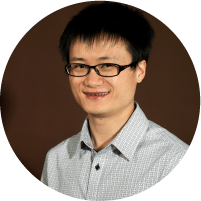
Yiping Fang
Stochastic Optimization
Yiping Fang is a lecturer at CentraleSupélec.
His research focuses on stochastic models, stochastic and robust optimization, and reinforcement learning with applications to risk and cyber-physical systems.
Publications: Profile

Hedi Hadiji
Associate Professor
Associate Professor at CentraleSupélec.
Publications: —
Maya Hage Hassan
Associate Professor
Associate Professor at GEEPS (CentraleSupélec).
Publications: Profile

Charlotte Laclau
Ethical and organizational aspects
Charlotte Laclau is an Associate Professor at Télécom Paris and member of the LTCI laboratory.
Her research focuses on machine learning for complex data, fairness in relational data, and unsupervised learning for high-dimensional datasets.
Publications: Google Scholar

Yannick Le Cacheux
Machine Learning
Yannick Le Cacheux is a lecturer at CentraleSupélec and founder of the AI consulting company Manifold Technology.
His work focuses on multimodal models combining computer vision and natural language processing.
Publications: Google Scholar

Fragkiskos Malliaros
Network Science Analytics
Assistant Professor at CentraleSupélec and an associate researcher at Inria Saclay (OPIS team). He was a postdoctoral researcher at UC San Diego (2016-17) and École Polytechnique (2015-2016) where he received his PhD in Computer Science in 2015.
His research interests span the broad field of data science, focusing on graph machine learning and graph-based information extraction.
Publications: Google Scholar

Ioane Muni Toke
Artificial Intelligence for Finance
Associate Professor at CentraleSupélec, Université Paris-Saclay. He previously worked at the University of Texas at Dallas and the University of New Caledonia.
His research focuses on probability and statistics applied to quantitative finance, especially financial market microstructure and limit order books.
Publications: Profile

Wassila Ouerdane
Multi Agent Systems
Assistant Professor in Computer Science at CentraleSupélec and a member of the MICS Lab. She holds a PhD in Computer Science from the University of Paris Dauphine in 2009.
Her research is related to Knowledge Representation and Reasoning within the context of Explainable AI, with the aim of using formal tools from AI and decision theory to specify agent reasoning (resolving conflicts, explaining decisions, etc.) and facilitate agent communication (dialogue protocol).
Publications: Profile
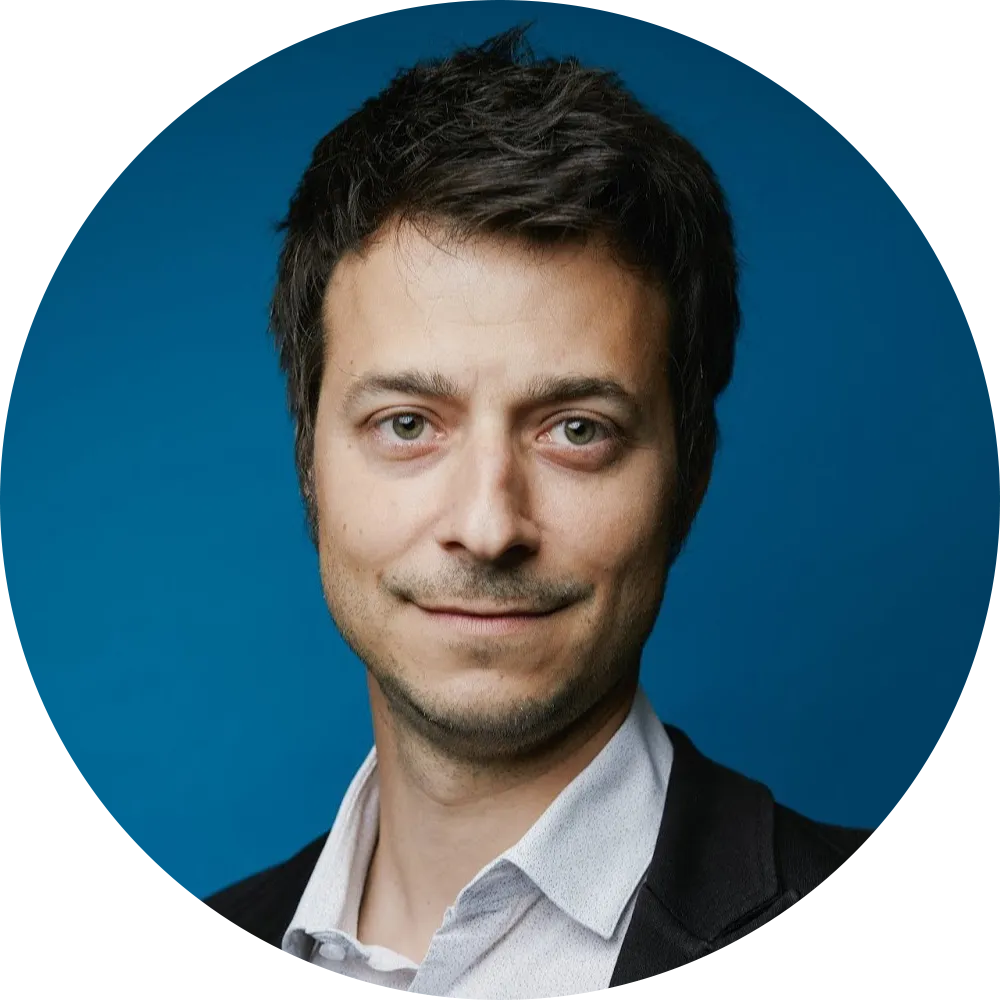
Frédéric Pascal
Advanced Statistics
Full Professor in AI at the L2S lab at CentraleSupélec, University Paris-Saclay. Since December 2019 he is the director of the AI@CS Hub coordinating artificial intelligence activities.
He is also the Givaudan chair in data sciences and has been part of the executive committee of the DATAIA institute, where he later became Co-Director and VP for AI at University Paris-Saclay.
Publications: Profile
Jean-Philippe Poli
Foundations of Artificial Intelligence
Senior expert in Artificial Intelligence at CEA-LIST. He received his PhD from Aix-Marseille Université and the Institut National de l’Audiovisuel in 2007 on the automatic structuring of television streams.
His research concerns symbolic Artificial Intelligence, in particular symbolic machine learning and eXplainable Artificial Intelligence (XAI).
Publications: Google Scholar

Gianluca Quercini
Big Data for AI
Gianluca Quercini is an Associate Professor at CentraleSupélec and member of the LISN laboratory.
His research interests include information discovery, information extraction and the semantic web.
Publications: Profile

Hugues Talbot
Optimization for Machine Learning
Hugues Talbot is Distinguished Professor in the Mathematics Department at CentraleSupélec and member of the Inria OPIS team.
He has authored over 300 scientific publications in mathematical morphology, geometry and optimization.
Publications: Profile
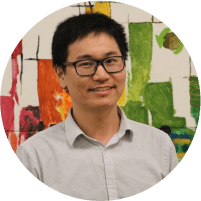
Zhiguo Zheng
Predictive Maintenance
Zhiguo Zheng is Assistant Professor at CentraleSupélec, Université Paris-Saclay.
His research focuses on modelling and reliability of complex systems, including prognostics, safety and maintenance.
Campus
AI at CentraleSupélec – At the Heart of the Paris-Saclay Ecosystem
Located within the world-class ecosystem of Université Paris-Saclay, the CentraleSupélec campus in Paris-Saclay offers an environment where Artificial Intelligence is not simply taught — it is actively developed, deployed, and researched at scale.
Ranked #1 in continental Europe and #13 worldwide in the 2025 Shanghai World Ranking, Université Paris-Saclay stands among the most research-intensive institutions globally. This excellence directly benefits students of the Master of Science in Artificial Intelligence through immediate exposure to cutting-edge scientific activity.
As a founding member of Université Paris-Saclay, CentraleSupélec plays a leading role within the Graduate School of Engineering and Systems Sciences. AI is a strategic pillar across both education and research.
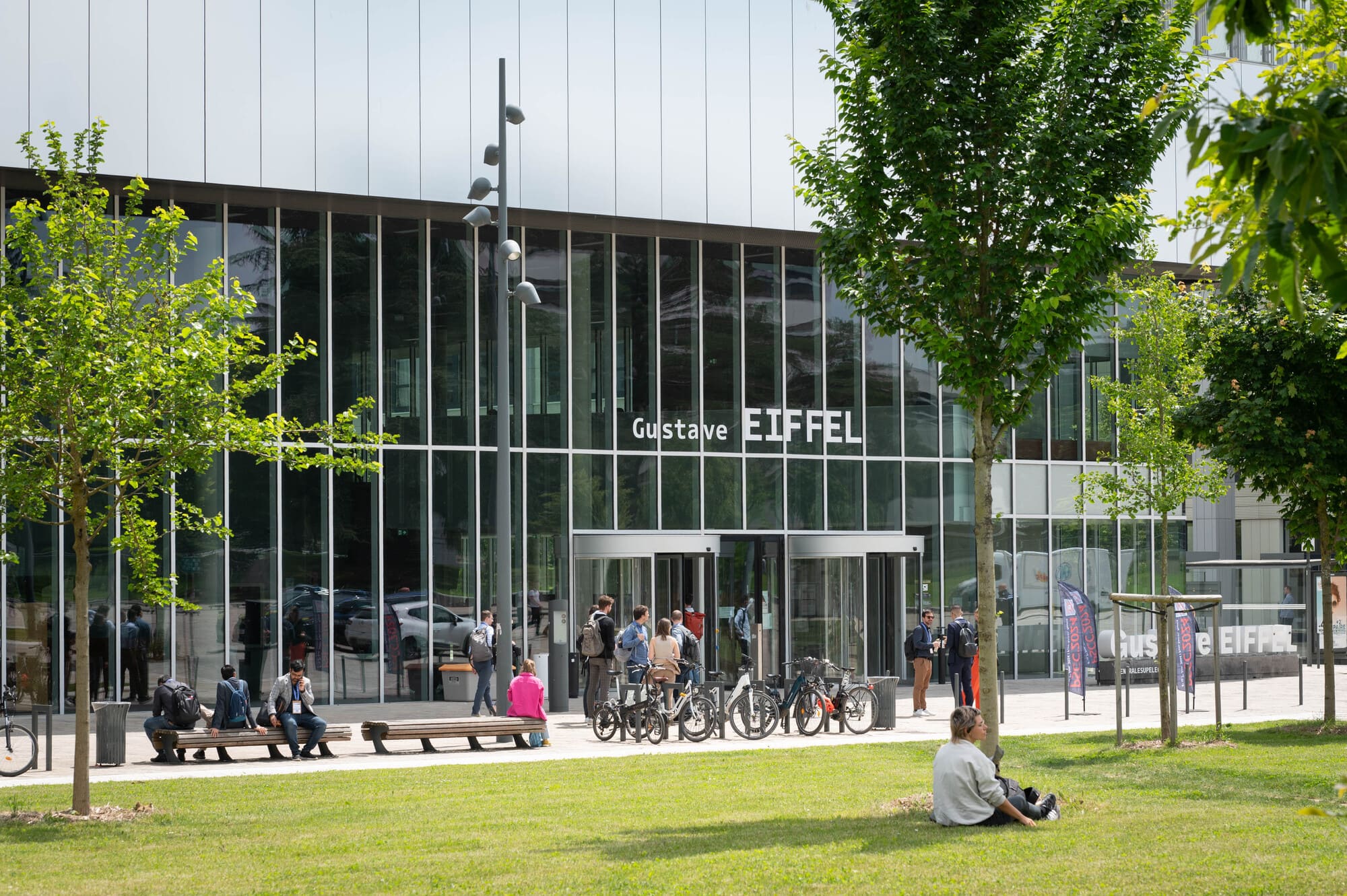
Paris-Saclay is more than a university campus — it is one of Europe’s largest scientific and technological clusters.
The AI ecosystem includes:
- Interdisciplinary Research Laboratories working on machine learning, computer vision, robotics, optimization, data science, and trustworthy AI
- Strong partnerships with major industrial actors and startups within the Paris-Saclay innovation hub
- The AI@CentraleSupélec (AI@CS) Hub, which federates AI initiatives across research, teaching, entrepreneurship, and industry collaboration
- Project-based learning deeply connected to real-world applications
Students are immersed in an ecosystem where AI research, engineering, and industrial transfer coexist in the same environment.
Artificial Intelligence is embedded across:
- Core graduate-level courses (advanced machine learning, deep learning, probabilistic modeling, optimization, AI systems)
- Research-driven seminars and lab immersion
- Applied projects conducted in collaboration with laboratories or industry partners
The proximity between faculty researchers and MSc students ensures close academic mentoring and direct exposure to state-of-the-art developments.
The Paris-Saclay campus hosts leading research institutions, major R&D centers, and technology companies within walking distance.
This concentration of talent fosters:
- Cross-disciplinary collaboration
- Access to high-performance computing resources
- Entrepreneurial opportunities within one of Europe’s most dynamic deep-tech ecosystems
For MSc AI students, this means acquiring advanced theoretical knowledge, and operating in an environment where AI innovation is actively shaping industry and society.
Financing
-
M1
Tuition Fees: €15,000, including €1,500€ deposit
M2
Tuition fees: €25,000 including €2,000 deposit.
The deposit is payable upon acceptance into the program and before registration.
This amount is later deducted from your tuition fees. Remaining tuition fees can be paid in one, two, or three installments before December.
For students holding a Crous scholarship, tuition fees are 0 €/year.
-
CentraleSupélec offers scholarships based on your academic excellence, and financial need based on resources. The scholarship is personalized depending on your personal situation.
Applications are possible once you get admission offer successfully. You will find the process for applying for the scholarship in the admission letter.
-
Housing
At CentraleSupélec, students can apply for a room in the residences on the campus.
Living costs
To help with your financial planning, you can find below estimated expanses for students at CentraleSupélec.
Expenses Price range Accommodation on campus 650€ - 750€ / month Full meal at campus cafeteria 7€ Express subway train ticket to Paris 6€ Phone & data subscription 20€ / month Meal at typical Parisian bistro 25€
Discuss with our students
What’s it like to study at CentraleSupélec? When should you apply? How should you make your application stand out? Why should you join us?
And where will you be living? If you want to know more about CentraleSupélec, feel free to ask!
Drop a message to our students and ask them how it is to live in France and to be part of the CentraleSupélec student community.